 neuralearn.com.au
What your brain
is actually doing.
If you've downloaded this guide, you know the feeling. Not just stress. Everyone has that. Something more specific: the inability to switch off. Racing thoughts at 2am when you're physically exhausted. A background hum of tension that's present even when nothing is technically wrong. The sense that you've tried everything, therapy, meditation, breathing exercises, sheer willpower, and while they help in the moment, nothing seems to actually change at a deeper level.
I've heard this from hundreds of people over the years, and from many of their children too. High-achievers. People who are excellent at managing their external world, but whose internal state has developed a life of its own.
Here is what I've found: this is not a willpower problem. It's not an effort problem. It's a brain pattern problem. Chronic stress leaves a measurable imprint in the brain, specific brainwave signatures, specific nervous system patterns, and those patterns don't change through thinking alone.
This guide will do three things. First, it will show you what's actually happening in your brain when anxiety takes hold. Second, it will give you a self-assessment that tells you how significant your pattern is, and whether the same applies to your child. Third, it will give you a complete simple 21-day protocol built from the same tools we use with clients between sessions.
Work through it carefully. The self-assessment matters. Your score shapes how you interpret everything that follows. If at the end you feel something shift, or you're curious about what your actual brain map would show, there's a link at the end for a conversation.
Over the coming weeks I'll also send you a short series of emails that go deeper on what's in this guide: the specific brainwave signatures behind chronic stress, how your HRV connects to recovery, and what the research shows about why standard interventions reach a ceiling. Keep an eye out for the first one.
Your Brain Pattern
Self-Assessment
Before reading the science or the protocol, take this assessment. Your score will tell you how established your stress pattern is, and how much runway the simple 21-day protocol can cover on its own versus where a deeper intervention becomes valuable.
Click a number for each question. Your result appears automatically when you've answered all eight.
Click the number that matches each statement honestly. There are no right answers, only accurate ones.
Adult version
Stress responses are proportionate and manageable. The simple 21-day protocol will build resilience as a preventive measure.
This is the most common pattern in high-achievers. The protocol will produce meaningful change. Brain mapping will show you exactly what's driving it.
The pattern is well-entrenched. Do the protocol, but brain mapping is strongly recommended. Conscious tools alone have limited reach here.
For your child (ages 10–14)
If you have a child you're concerned about, answer these about them using the same scale.
Click a number for each question. Your result appears automatically when you've answered all eight.
Protocol is a useful preventive tool. Age 10–14 is an excellent window to build nervous system habits.
The protocol is highly recommended. Unaddressed at this stage, patterns can compound through adolescence and affect academic and social development.
Early brain mapping is valuable here. At this score, the pattern is affecting your child's daily experience in ways that conscious strategies alone will struggle to reach.
What's Actually Happening
in Your Brain
Your brain isn't broken. It's adapted. Understanding the difference matters, because the same mechanism that created the pattern is the mechanism that can retrain it.
The threat-detection loop
Deep in the brain sits a small structure called the amygdala. Its job is to scan for danger and respond faster than conscious thought. When it detects a threat, real or perceived, it triggers a cascade: cortisol, adrenaline, and noradrenaline flood the system. Heart rate climbs. Muscles tense. Attention narrows.
This is life-saving in genuine danger. The problem arises when, through enough repetition, this response stops being triggered by specific events and becomes the brain's default operating mode. The amygdala is no longer responding to threats. It's generating them. The background hum isn't coming from your life. It's coming from a pattern your brain has learned.
"When we map an anxious brain, we don't see a broken brain. We see a highly adapted one that has learned to stay in a state of readiness. The question becomes: ready for what?"
The brainwave fingerprint of chronic stress
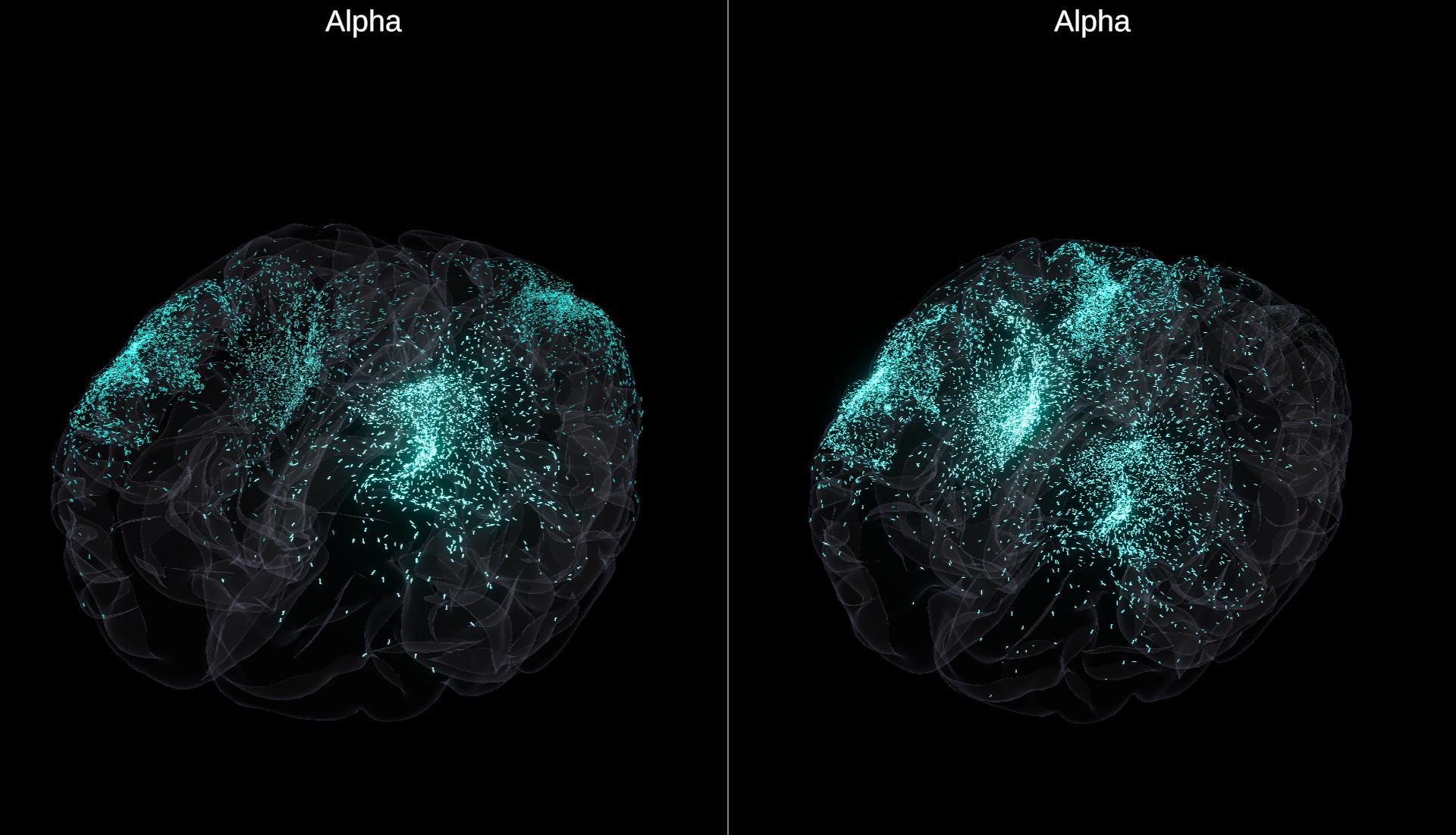
Every mental state has a corresponding pattern of electrical activity in the brain. We measure these using qEEG (quantitative electroencephalography). When we map someone experiencing chronic stress or anxiety, we consistently see the same two things:
Alpha is your brain's natural idle state: calm, alert, present. In the anxious brain, frontal alpha production is depleted. The calming buffer is thin. Meditation, breathing, and rest all attempt to increase this. Most succeed briefly. The pattern reasserts.
High-beta reflects rumination, worry, and cortical over-arousal. The brain is running hot, generating the neurological equivalent of a constant, low-level alarm signal. This is what produces the "wired but tired" feeling and the racing thoughts at 2am.
This combination of depleted alpha and elevated high-beta is the neurophysiological fingerprint of a chronically stressed nervous system. It is not a character flaw. It is a learned pattern. And patterns can be retrained.
The HRV window
Alongside brainwave patterns, Heart Rate Variability (HRV) gives us a second lens. HRV measures the tiny variations between your heartbeats, a signal governed by the autonomic nervous system, the part of you that controls stress response and recovery.
Healthy HRV reflects a nervous system that moves fluidly between activation and rest. Chronic stress compresses this variability, producing a system that is stuck in activation: reactive rather than resilient. Compressed HRV is one of the earliest detectable markers of burnout and sustained anxiety, often appearing measurably before other symptoms become obvious.
At NeuraLearn, we measure both EEG and HRV to build a complete picture of how your brain and body are operating together, not just a single data point.
reduced anxiety after 10 sessions
brainwave pattern change
measured simultaneously
Why Smart People Still
Can't Switch Off
There is no shortage of advice on managing anxiety. Breathe more. Sleep better. Exercise consistently. Meditate. Reduce screen time. Limit caffeine. Practise gratitude. Cut alcohol.
Much of this is genuinely good, and several of these strategies form the foundation of what follows in this guide. But here is the honest reality: for people with established stress patterns, these approaches provide relief in the moment without producing lasting change at a deeper level. The reason is structural.
Conscious strategies work at the level of conscious thought. They engage your prefrontal cortex: the deliberate, reasoning, self-aware part of your brain. But the anxiety loop doesn't live there. It lives in the nervous system, in the default brainwave patterns of the subcortical brain. Changing your thinking, on its own, does not reliably change the underlying firing pattern that's generating the thinking.
Think of it this way: if your computer's operating system has been running in high-performance mode for years, updating your applications won't change the underlying drain on the battery. The work needs to go to a different level. That's not a criticism of therapy, meditation, or lifestyle change. It's a description of where they operate versus where the problem lives.
This is the gap that brain-map-guided neurofeedback is designed to address. Not instead of conscious strategies, but alongside them, operating at the level those strategies can't reach.
Six Evidence-Based
Nervous System Tools
These are the same tools we teach clients to use between neurofeedback sessions. They work by targeting specific points in the stress-response chain, not just "calming down" in a general sense, but interrupting or modifying the physiological mechanism at a specific point.
Use them as a daily practice. They will produce meaningful change within the simple 21-day protocol. What they will not do, on their own, is retrain the underlying brainwave pattern that generates the stress response. That distinction matters, and by Day 21 you'll have a sense of how much of the work they can and can't do for your particular pattern.
A double inhale through the nose, two quick sniffs, followed by a long, slow exhale through the mouth. Two to three rounds, used when you notice stress rising, can interrupt the alarm loop in under 90 seconds. The mechanism is specifically in the exhale: a slow out-breath reduces heart rate via the vagus nerve, signalling to the brain that the immediate threat has passed. This is not relaxation as an aspiration. It is direct vagal stimulation with measurable cardiac effect.
Accurately naming an emotion, specifically saying something like "I notice I feel anxious right now", has been shown in peer-reviewed research to measurably reduce amygdala activation and increase prefrontal cortex engagement. This is the region responsible for regulation and considered decision-making. The key word is "accurately": vague labels ("I feel bad") produce a weaker effect than precise ones ("I feel dread about the presentation tomorrow"). The act of observation moves processing from the reactive brain to the observing brain. It sounds simple because it is, but the neural mechanism is real.
High-beta arousal is partly physical: stress hormones need to be metabolised before the brain can shift state. Attempting meditation or breathing exercises while cortisol and adrenaline are still elevated is like trying to cool a room by opening a window while the heater is running. A 10-minute brisk walk before a meditation or breathing session significantly increases the likelihood the practice will produce genuine calm rather than frustrated attempts at calm. Burn the fuel first, then settle.
Splashing cold water on your face or holding cold water against your wrists activates the dive reflex via the trigeminal nerve. This rapidly increases parasympathetic tone, the calming branch of the autonomic nervous system, and can shift the nervous system out of over-activation within seconds. The neurophysiology is well-established even if the approach sounds surprisingly low-tech. Useful in the moment, before a difficult conversation, before bed if racing thoughts have started, or as a mid-afternoon reset.
The brain transitions naturally through alpha wave activity on its way into sleep. Screens, bright lighting, and stimulating content in the hour before bed suppress alpha production and keep high-beta elevated, which is the exact opposite of what sleep onset requires. A 45-minute screen-free wind-down on at least four nights per week measurably improves sleep onset time and reduces morning cortisol. Consistency matters more than duration: four imperfect nights beats one perfect night.
Stress accumulates quietly, and its patterns are often invisible until you look. Choosing one simple indicator to record each morning, sleep quality out of 10, morning energy, or mental clarity, builds a dataset over three weeks that consistently reveals triggers or cycles that weren't obvious before. The data you collect during the simple 21-day protocol also becomes useful context for a brain map conversation: Dr. Ardy will be able to see the pattern before the session begins. Awareness consistently precedes change.
The NeuraLearn
Simple 21-Day Calm Brain Protocol
This is a complete system, not a collection of tips. Follow it as written for 21 days. Track your morning variable daily. Re-take your assessment score on Day 21. Most people see a 30–50% improvement in their total score with consistent practice. The gap between your Day 1 and Day 21 scores is important data: it tells you how much of the work the conscious tools can do, and where the deeper layer lies.
The three rules: Track every morning (60 seconds). Consistency beats intensity. Do the tools daily, not when you remember.
If your Day 21 score is still 9 or above (or your child's is), the protocol has done what it can. The remaining pattern is running below the level these tools reach. That's not a failure. It's a clear signal that the work needs to go to the operating-system level.
What a Brain Map
Actually Shows
Jack Lin's external life looked put-together. Consistent training, a career he was building, a wide social circle. But underneath there was a background hum he found hard to name precisely. Difficulty switching off. Sleep that should have been restorative but never quite was. Tension in conversations with his parents that he didn't want. Social situations that should have been easy, like meeting new people or talking to a girl he was interested in, carried more weight than they needed to. He had already done the obvious things. Regular exercise. Better sleep habits. He understood his body well. The background tension followed him anyway.
His brain map made the picture legible:
After ten sessions, Jack Lin's high-beta activity normalised into the expected range. His resting alpha rhythms strengthened measurably. The sleep quality marker (the single largest shift in his profile) moved from well outside the normal range to within it. But the changes that mattered most to him were not on a chart. Conversations with his parents stopped feeling like something he had to manage. Social situations that had previously felt loaded, meeting new people, approaching someone he was interested in, lost most of their weight. The background noise that had followed him through his days simply began to lift.
A 15-minute call is a good place to start. We'll talk through what you're noticing, what a brain map would show, and whether there's a pattern worth looking at more closely.
Not All Neurofeedback
Is Equal
There are neurofeedback providers across Australia, and quality varies significantly. Here is what sets NeuraLearn apart.
Every program starts with a full qEEG brain mapping session. We don't apply a generic protocol and hope for the best. Your training is built entirely from your map.
Dr. Ardy holds a PhD in Neuroscience, lectures at university, and has specialised in HRV and EEG research for years. This is not a franchise with a scripted protocol.
Integrating brain and body data provides a complete picture of how your nervous system is actually operating. Not standard practice at most providers.
Every assessment produces a detailed written document explaining your brain pattern in plain language: what it shows, what it means for your daily experience, and personalised recommendations.
"I've worked with Dr. Ardy for a few years now and he is a game changer. I've been less stressed, more productive, and have better relationships with friends and family. His approach with the use of brain and heart data really made a difference."
Ali E., NeuraLearn client
Two Ways to Go
Deeper
If you've completed the simple 21-day protocol and still feel the pattern, or if your assessment score is in the 17–24 range, the next step is seeing it on a brain map. Many clients start with the Assessment before deciding whether to continue to training.
- Full qEEG brain mapping session (Sydney clinic)
- HRV assessment and nervous system analysis
- One-hour results review with Dr. Ardy
- Comprehensive Report, yours to keep
- Personalised protocol recommendations
Full cost deducted if you proceed to training
- Everything in the Brain Assessment
- Personalised training protocol built from your map
- Full neurofeedback training block at the Sydney clinic
- Progress tracked and documented across the program
- Updated Comprehensive Report at completion
- Ongoing support and protocol adjustments
Sessions are calm, non-invasive, and comfortable. EEG sensors rest gently on the scalp with no discomfort. Most clients describe the sessions themselves as relaxing.
What Would Your
Brain Map Show?
If any of this has resonated, or if your Day 21 score tells you something is still running underneath, the most useful next step is a conversation.
- What pattern your brain likely shows, based on what you're describing
- Whether neurofeedback is appropriate for your specific situation
- One thing you can adjust in the protocol this week based on your scores
- Whether your child's scores warrant early assessment
Not a sales call. If NeuraLearn isn't the right fit for your situation, Dr. Ardy will tell you that directly.
Not ready for a call yet? Watch for the email series that follows this guide. Over the next few weeks you'll receive a short sequence going deeper on the science: what the specific brainwave patterns behind chronic stress actually look like, how your HRV data connects to recovery, and what targeted neurofeedback training reaches that these strategies can't. The first email will arrive shortly.